





Our experts, in anticipation of the 2025 year-end results and the drafting of plans for 2026, has prepared a brief overview of the dynamics of nominal changes in wages, salaries, and other labor costs as reflected in the Labour Cost Index (LCI).
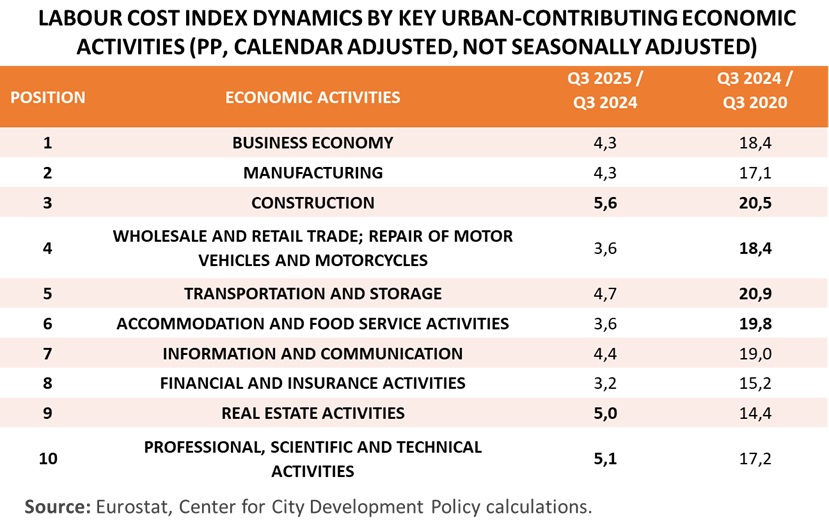
Interestingly, among the economic activities that play a primary role in any city’s economy by contributing the most in terms of value-added, preliminary estimates identify the top 3 leaders in LCI growth across 27 European countries for 2025: Construction (up 5.6 pp compared to Q3 2024), Professional, scientific and technical activities (5.1 pp), and Real estate activities (5.0 pp).
The composition of this top three differs from the leaders of the 2020–2024 period, when the rankings were headed by Transportation and storage (20.9 pp) and Construction (20.5 pp), followed by Accommodation and food service activities and Information and communication with increases of 19.8 and 19.00 pp, respectively.
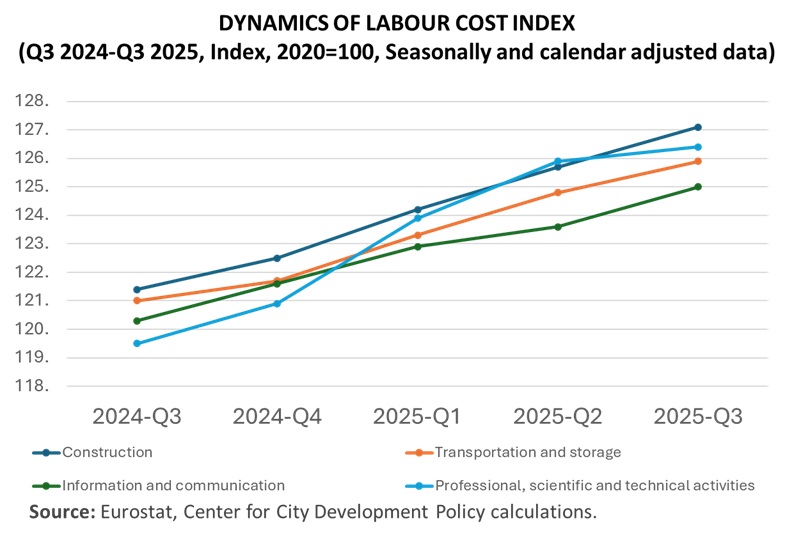
It is important to note that, based on the annual dynamics of the first three quarters of 2025, salaries in the "Professional, scientific and technical activities" category gained sharp positive momentum in the first and second quarters of 2025, though the growth rate slowed down in the third quarter. Nevertheless, wages are expected to grow higher than the average for the business economy. Furthermore, in the "Information and communication" sector, we observed an acceleration in the growth dynamics of labor costs during the third quarter.
It is interesting to highlight the countries with the most positive Labour Cost Index dynamics in "Professional, scientific and technical activities."
In general, it can be said that in more than half of European countries, wages in "Professional, scientific and technical activities" grew more than average within the Business Economy activities between 2020 and 2025. Particularly noteworthy is the significantly higher wage growth rate in Estonia (23.3 pp), Latvia (15.6 pp), Czechia (12.2 pp), and Lithuania (11 pp). Next, we can identify a group of countries with a moderate excess in wage growth relative to the Business Economy—namely Germany, Finland, Greece, Norway, Italy —ranging from (5.1 pp) to (3.2 pp). Closing the list of countries with a slight excess are Luxembourg, Spain, Croatia, and Ireland, in the range of (0.9 pp) to (0.3 pp).
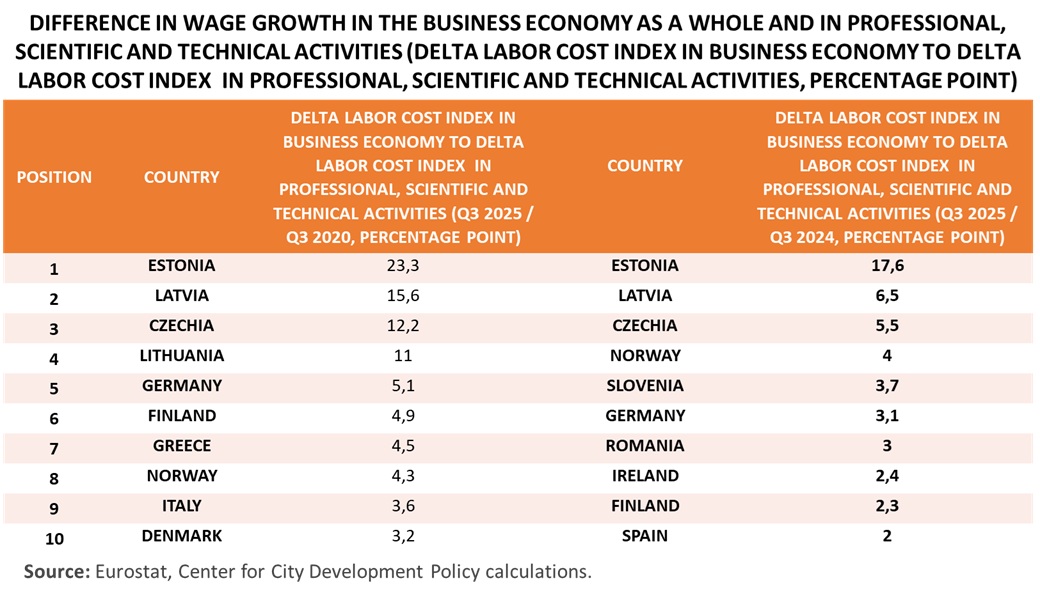
If we compare 2025 to 2024, it is particularly noteworthy to highlight the difference in wage growth dynamics in "Professional, scientific and technical activities" relative to other activities in the Business Economy in Estonia at (+17.6 pp), followed by a fairly large group of countries with moderate levels of wage excess, which includes both the largest and smallest European economies—Latvia, Czechia, Norway, Slovenia, Germany, and Romania—in the range of 6.5 pp–3 pp. The group with a slight excess includes Ireland, Finland, Spain, in the range of 2.4 pp–2 pp.
We believe that this trend of accelerating wage growth in "Professional, scientific and technical activities" in 2025, compared to traditional growth leaders and the Business Economy as a whole, may signify a fairly positive trend in terms of increasing potential and deepening the intellectual and innovative orientation of the European economy.
In anticipation of Christmas and the New Year, our team sincerely wishes success and the realization of the boldest professional ambitions to everyone who loves their work and takes true pleasure in what they do! We also wish for your material well-being to grow along with your competencies!
See you in the New Year 2026!
.webp)



.webp)




.svg)